What Is Replenishment Analysis and How It Supports Demand Planning

In fashion, demand is rarely stable. Trends shift quickly, consumer sentiment changes with seasons and culture, and one viral moment can empty shelves overnight. Yet many brands still rely on basic sales reports or gut feeling to decide what to restock, when, and in what quantity.
This is where replenishment analysis becomes critical.
Replenishment analysis goes beyond knowing what sold. It helps fashion brands understand what deserves to be replenished, what should be scaled back, and how demand patterns evolve over time. When done correctly, it becomes a core pillar of demand planning, inventory efficiency, and revenue growth.
What Is Replenishment Analysis?
Replenishment analysis is the process of identifying products, attributes, or categories that are restocked repeatedly because of sustained demand.
In fashion, replenishment usually signals:
- Strong sell-through
- Consistent consumer interest
- Proven product-market fit
- Lower demand volatility compared to trend-driven items
Unlike trend analysis (which focuses on what’s new or emerging), replenishment analysis focuses on what keeps performing well enough to justify repeat inventory investment.
Why Replenishment Analysis Matters in Fashion
Fashion businesses operate with thin margins and high operational risk. Over-replenishing ties up cash and leads to markdowns, while under-replenishing results in missed revenue and frustrated customers.
Replenishment analysis helps brands answer questions like:
- Which products are safe to restock?
- Which attributes drive repeat demand?
- What should form the backbone of future assortments?
- Where should we allocate inventory budgets with confidence?
When embedded into planning workflows, replenishment analysis reduces guesswork and enables more predictable growth.
The Role of Replenishment Analysis in Demand Planning
Demand planning isn’t just forecasting volume, it’s deciding where demand is reliable enough to plan around.
Replenishment analysis supports demand planning by:
- Identifying demand stability vs. demand spikes
- Highlighting evergreen products and attributes
- Improving buy depth decisions
- Informing size, color, and feature allocation
- Reducing reliance on reactive restocking
Instead of planning purely around historical sales totals, planners can focus on repeat replenishment behavior, which is often a stronger indicator of future demand.
Key Dimensions of Replenishment Analysis in Fashion
Replenishment analysis can be broken down into multiple layers, each revealing different insights.
1. Product-Level Replenishment
This focuses on specific SKUs that are restocked multiple times. These are often:
- Core styles
- Bestsellers
- Seasonless items
- Proven silhouettes
Product-level analysis helps brands protect their revenue drivers while experimenting elsewhere.
2. Attribute-Level Replenishment
Sometimes it’s not the exact product that matters, but the attributes behind it:
- Color
- Fabric
- Fit
- Length
- Pattern
- Neckline
- Sleeve type
Understanding which attributes are consistently replenished allows brands to design smarter future collections.
3. Category-Level Replenishment
This reveals which categories are structurally strong, even when trends change. For example:
- T-shirts vs. statement tops
- Dresses vs. co-ords
- Activewear basics vs. seasonal capsules
Category-level replenishment insights are essential for long-term assortment planning.
Common Challenges Without Replenishment Insights
Brands that don’t actively analyze replenishment patterns often face:
- Overstocked trend pieces
- Frequent markdowns
- Poor cash flow
- Inventory imbalances across categories
- Reactive buying decisions
- Missed opportunities to scale winning products
In many cases, replenishment decisions are made manually or based on limited internal data, making it hard to see broader market patterns.
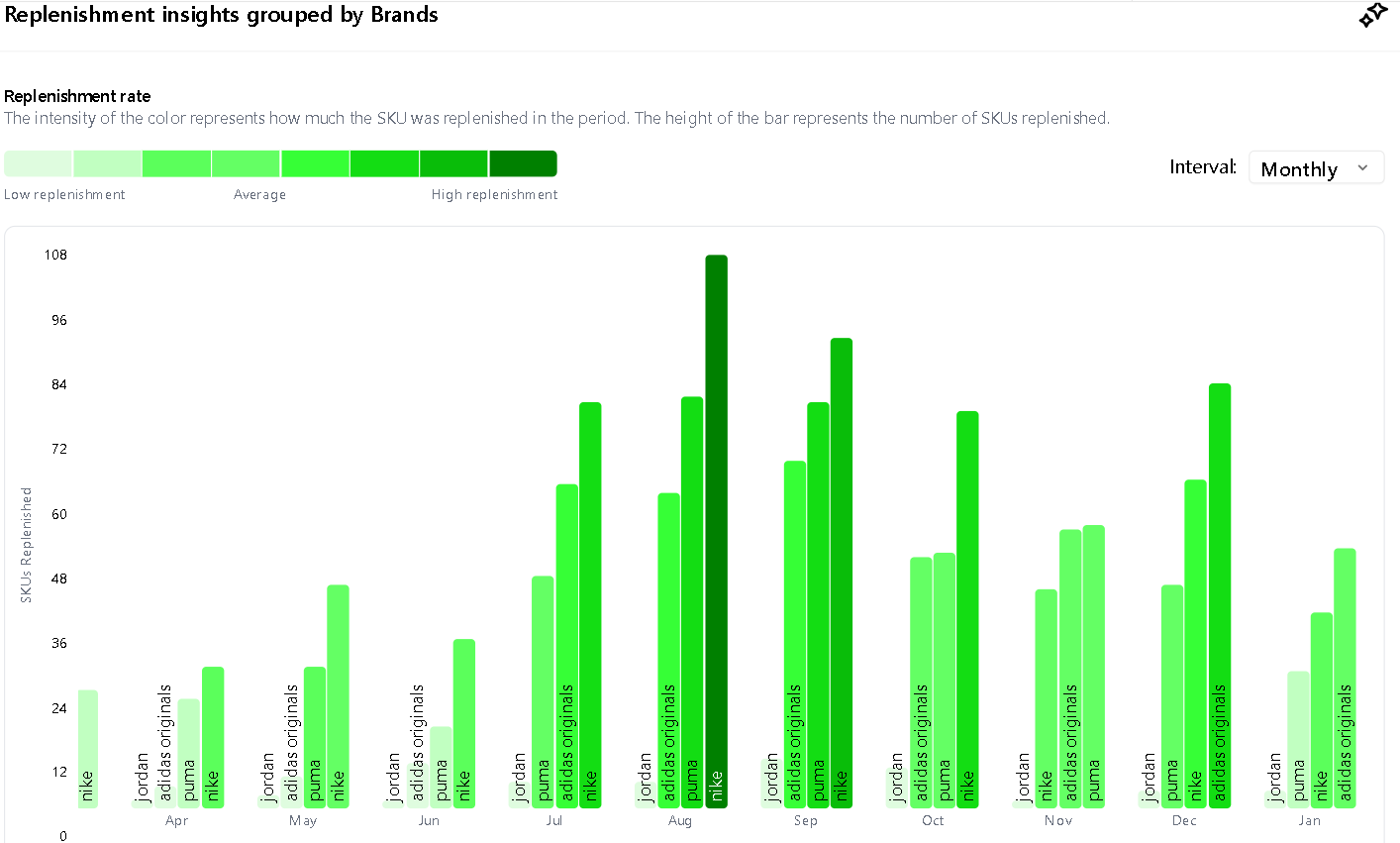
Replenishment Insights Grouped by Brands
Beyond category-level analysis, replenishment decisions often require a closer look at brand-specific behavior within the market. Different brands follow distinct replenishment strategies based on positioning, price tier, and customer expectations, which means category averages alone can hide important nuances.
Replenishment insights grouped by brands allow teams to focus on selected or desired brands and understand how frequently products are restocked, which attributes are consistently replenished, and where supply strategies differ across competitors. This view is particularly useful when assessing how leading brands sustain availability on high-demand items or how emerging brands manage stock depth differently.
By analyzing replenishment at the brand level, fashion teams can:
- Identify brands that rely heavily on repeat restocking versus seasonal drops
- Compare replenishment intensity across competing brands within the same category
- Spot gaps where a brand may be under-serving demand despite strong market traction
This level of visibility supports more informed decisions around competitive benchmarking, assortment planning, and supply chain alignment, especially when brands are used as reference points for market positioning or expansion strategies.
Replenishment Insights with Woven Insights
Woven Insights helps fashion brands move from intuition-led replenishment to data-backed replenishment strategy by analyzing how products are restocked across the market.
Below are the key replenishment insights offered by Woveninsights, each designed to support smarter demand planning and inventory decisions.
Replenishment Grouped by Categories
This insight shows which product categories are being replenished most frequently across selected brands or retailers.
It helps teams:
- Identify structurally strong categories
- Prioritize inventory budgets
- Balance core vs. trend-led assortments
- Plan depth more confidently
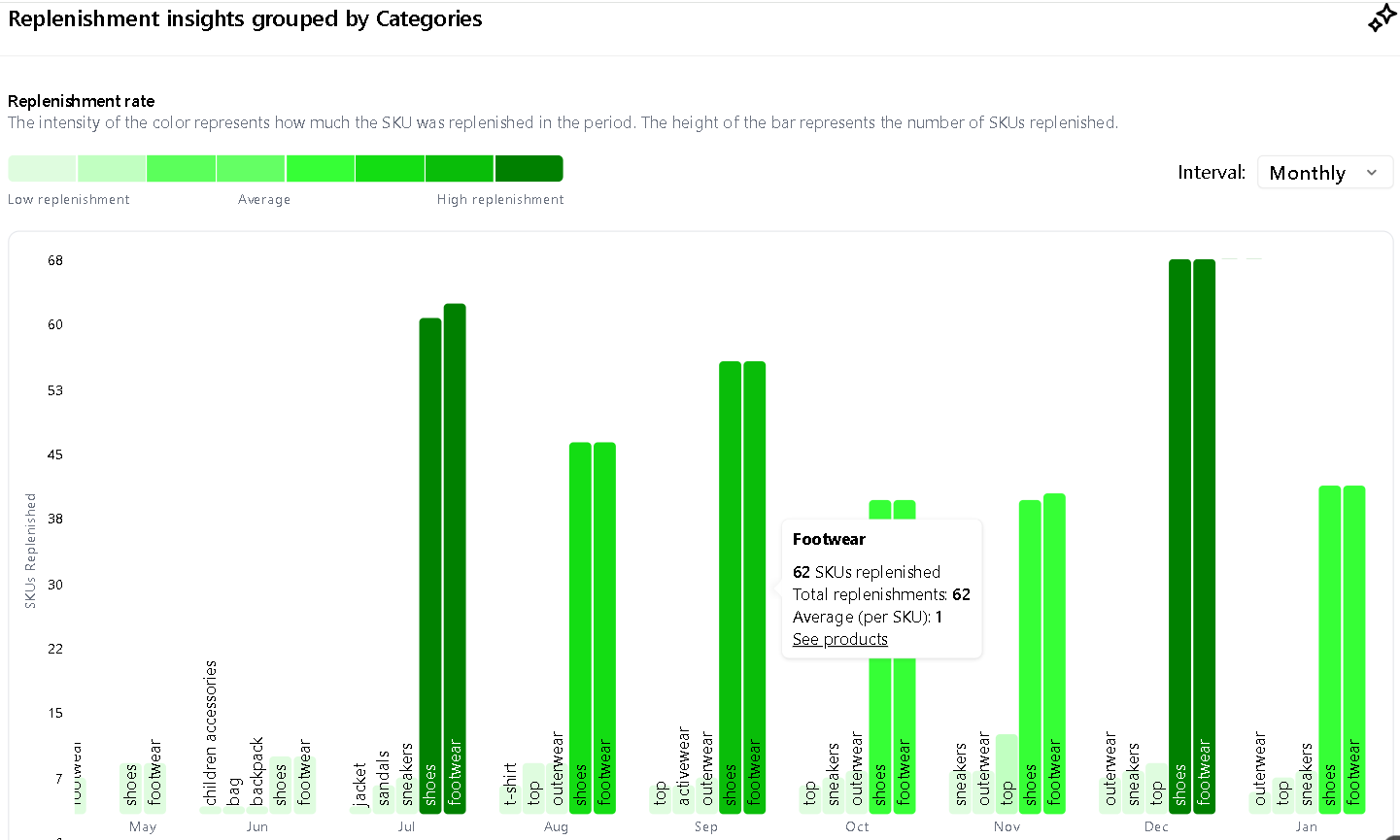
Instead of asking “What category should we push?”, brands can see where the market is consistently reinvesting.
Replenishment Grouped by Colors
Color plays a major role in sell-through and repeat demand. This insight reveals which colors are being replenished repeatedly, not just launched once.
It helps brands:
- Identify safe color bets
- Reduce color over-assortment
- Improve color allocation per style
- Align design decisions with proven demand
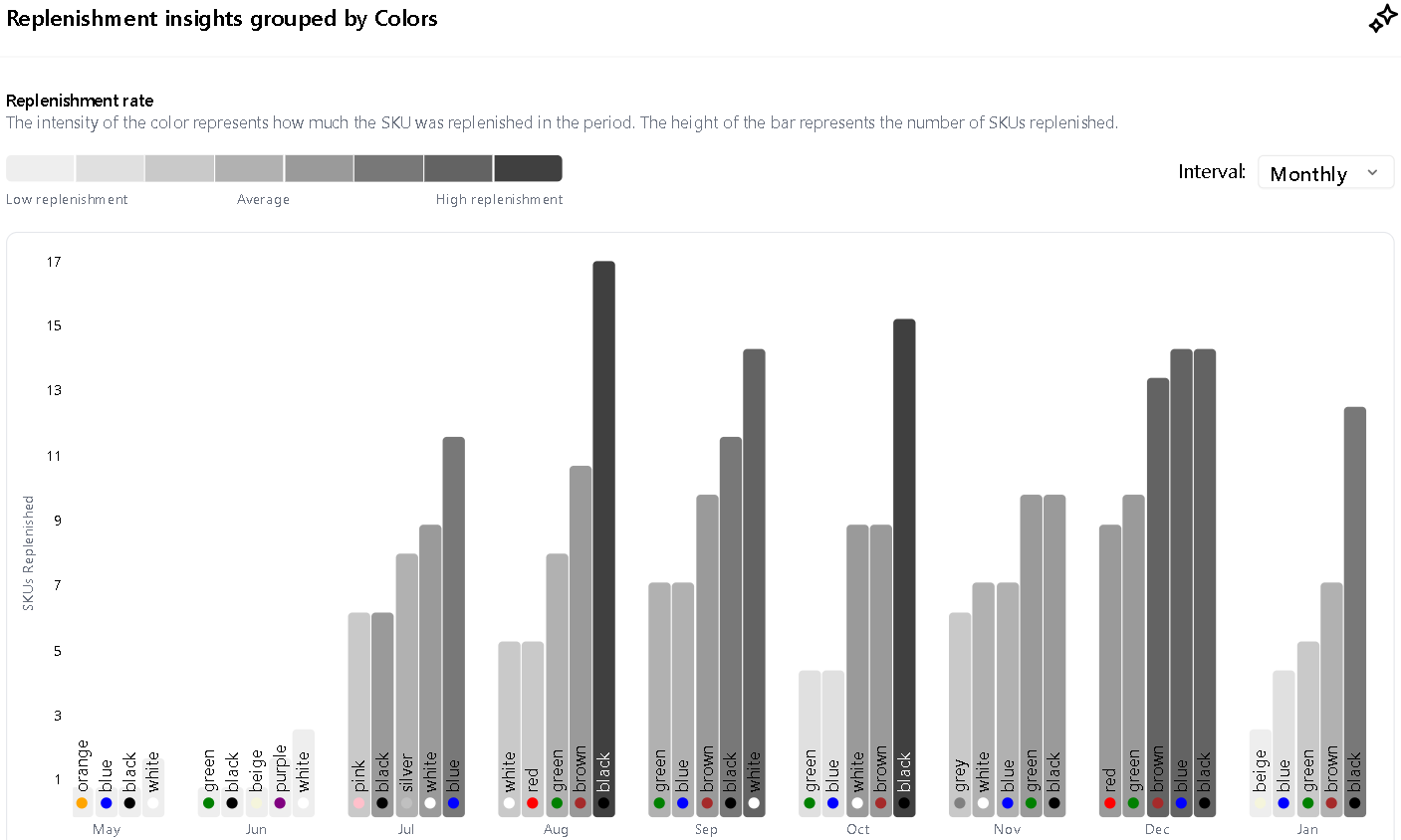
This is especially valuable for brands struggling with slow-moving colorways or excessive markdowns.
Replenishment Grouped by Features
This insight focuses on design and product features that drive repeat replenishment such as:
- Fit types
- Sleeve styles
- Lengths
- Fabrics
- Necklines
- Functional details
It enables brands to:
- Understand what consumers repeatedly buy
- Design with demand-backed features
- Reduce experimental risk
- Strengthen future collections
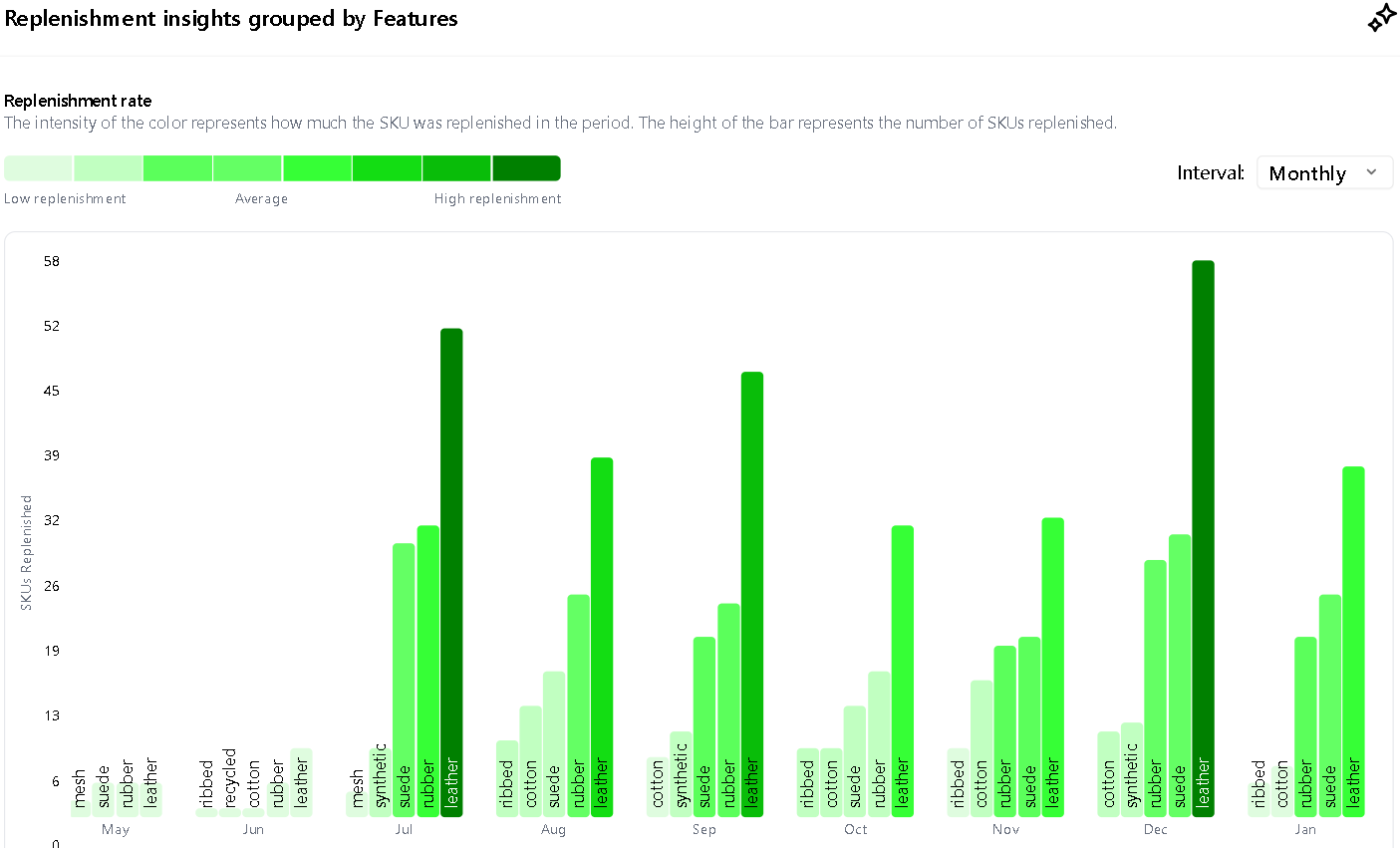
Rather than designing based on assumptions, teams can ground decisions in real market behavior.
How Replenishment Insights Translate to Better Business Outcomes
When replenishment insights are embedded into planning and merchandising workflows, brands experience:
- Higher sell-through rates
- Reduced markdown dependency
- Improved inventory turnover
- Stronger demand forecasting
- Better alignment between design and demand
- Increased confidence in buy decisions
Most importantly, replenishment analysis allows brands to scale what works while managing risk intelligently.
Conclusion
In an industry driven by speed and uncertainty, replenishment analysis offers stability.
It helps fashion businesses shift from reactive restocking to strategic demand planning, grounded in evidence rather than instinct. By understanding what the market repeatedly invests in; across categories, colors, and features, brands can build assortments that perform consistently, not just occasionally.
With tools like Woveninsights, replenishment analysis becomes accessible, scalable, and actionable turning data into a competitive advantage rather than a reporting exercise.
About Woveninsights
Woveninsights is a comprehensive market analytics solution that provides fashion brands with real-time access to retail market and consumer insights, sourced from over 70 million real shoppers and 20 million analyzed fashion products. Our platform helps brands track market trends, assess competitor performance, and refine product strategies with precision.
Woveninsights provides you with all the actionable data you need to create fashion products that are truly market-ready and consumer-aligned.
Click on the Book a demo button below to get started today.
